Remember when I got my first robot vacuum? My wife laughed at me for spending that much on what she called “a fancy Roomba.” Fast forward to 2026, and I’m watching the same technology revolution happen in hotels and restaurants – except this time, the stakes are much higher, and honestly? I think we’re on the verge of something really good.
Let me tell you what I’ve been seeing.
Why This Year Feels Different
If you looked at CES in January, you’d have noticed something different. For the first time, robots weren’t just booth attractions – they were being presented as working tools with real deployment numbers. The European hotel tech expos told the same story. This isn’t concept technology anymore.
The numbers back this up. We’re looking at a hospitality robotics market sitting around $760 million right now, projected to hit $2 billion by 2031. But here’s what matters more than the money: hotels are buying these things because they need them, not because they’re cool.
And I’ll be blunt – we need them because the labor situation in hospitality is broken.
Over half of restaurant operators told me labor shortage is their number one problem. Hotels are spending a third of their revenue just on labor costs, and they still can’t find enough people to cover night shifts. Something had to give, and automation is what gave.
What These Robots Actually Look Like (Spoiler: Not What You’re Imagining)
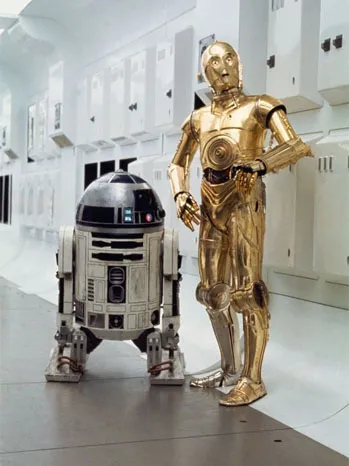
When I tell people I’m consulting on hotel robotics, they picture C-3PO at the reception desk. I have to stop them right there.
The delivery robots are the real workhorses. Picture a moving box about waist-high with a friendly LED face. That’s it. They roll around delivering towels, room service, toiletries – anything guests request.
Take the Residence Inn by LAX as an example. Guest orders room service at 2 AM. Robot delivers it in twelve minutes. Night clerk doesn’t have to leave the desk. The hotel became the #1 revenue earner per room in their entire area because they could suddenly offer 24/7 delivery without paying for three shifts of runners. Room service revenue literally doubled.
The cleaning robots handle floors – vacuuming, mopping, UV sanitization. Mostly they work overnight when guests are sleeping. Here’s what surprised me: when one hotel tried removing their cleaning robots during a budget crunch, the housekeeping staff staged what the GM described as “a near-revolt.” Turns out nobody misses destroying their knees and back vacuuming endless hallways.
The reception robots are really just fancy information kiosks. They answer the questions humans hate answering for the hundredth time: “Where’s the pool?” “What time is breakfast?” “How do I connect to WiFi?” This frees the actual front desk staff to handle the complex stuff – the late check-in problem, the guest complaint, the personalized recommendation.
Why I’m So Confident Humans Aren’t Going Anywhere
Let me put on my computer science hat for a moment – because my background is actually in AI systems, and I need to share something important that most people don’t understand about this technology.
AI systems and robots are not perfect. They never will be. And I say this with complete confidence because I understand how they work under the hood.
Here’s what people don’t realize: AI systems need constant supervision and training. They hallucinate – they make things up, they misinterpret situations, they fail in unpredictable ways. I’ve seen AI systems confidently deliver the wrong item because they misidentified it. I’ve seen robots get confused by unexpected obstacles and just… stop.
But there’s something even more fundamental: these systems need enormous computing resources. When those resources get stretched – when the system is overloaded – they start taking shortcuts to complete tasks. Sometimes that means omitting steps. Sometimes that means lower quality output. It’s like a tired human cutting corners, except the AI doesn’t even realize it’s doing it.
And power? That’s a hard limit that no amount of engineering will fully solve. More capable AI needs more power. More robots need more power. Energy is finite. Costs are real.
I can tell you with absolute certainty: robots will not take over human jobs in hospitality.
Especially not in hospitality, where the human experience is so delicate and nuanced. You know what’s the most difficult thing to automate? Understanding that a guest is frustrated but trying to be polite. Noticing that someone’s had a bad day and could use a kind word. Knowing when to engage and when to give someone space. Picking up on the thousand tiny social cues that make the difference between adequate service and genuine hospitality.
Robots can vacuum a floor reliably (most of the time). They cannot read a room.
The technology people fear – the AI that can truly replace human judgment, empathy, and creativity – doesn’t exist. And given the fundamental limitations I just described, I don’t think it will exist in our lifetimes.
What we have instead is useful automation for repetitive, physical, rule-based tasks. That’s it. That’s actually all we have. And honestly? That’s exactly what we need.
The Part That Actually Excites Me: What This Means for People
Look, I’m going to say something that might be controversial: I don’t think robots are taking jobs. I think they’re creating new, better jobs.
Let me explain with a real example.
There’s a boutique hotel in Amsterdam that recently deployed robots. Their head housekeeper, Maria, used to spend her shifts running between floors, answering calls for extra pillows, supervising cleaning, and basically being exhausted.
Now? Maria oversees the cleaning robots, but she spends most of her time doing what she actually trained for: quality control and those personal touches that make guests feel special. She arranges fresh flowers in suites. She notices when a business traveler might need an iron and has one waiting. She spots when someone’s celebrating an anniversary and coordinates with the kitchen for a surprise. In interviews, she’s said: “I finally have time to actually care for guests instead of just cleaning rooms.”
That’s the transformation I’m seeing everywhere. The robots handle repetitive physical tasks. Humans get to be human again.
The Skills That Will Matter Tomorrow
Here’s where it gets interesting for anyone working in hospitality or thinking about entering the industry.
The jobs aren’t disappearing – they’re evolving. And I’d argue they’re evolving in a good direction.
Tomorrow’s hotel cleaner won’t just clean. They’ll be a quality supervisor who understands both the robots and the guest experience. They’ll troubleshoot technical issues. They’ll know when automation is sufficient and when human touch is needed. That small flower on the pillow? The robot can’t do that. But it can do the vacuuming so the cleaner has time to care about flowers.
Tomorrow’s concierge won’t waste time answering basic questions – robots handle that. They’ll be relationship managers and experience designers. They’ll remember Mrs. Johnson prefers a quiet room away from elevators. They’ll notice patterns and anticipate needs.
Tomorrow’s restaurant host won’t run food – robots will. They’ll manage guest experience, handle complex situations, read body language, turn a disaster into a memorable recovery story.
These aren’t lower-skill jobs. They’re higher-skill jobs that require emotional intelligence, creativity, and technical literacy. They also pay better because they add more value.
Deloitte’s 2026 hospitality report says something I completely agree with: the winners in this transformation won’t be the properties that replace humans with robots. The winners will be those that free humans from repetitive tasks so they can focus on what we do better than any machine ever will – empathy, creativity, and genuine connection.
What Guests Actually Think (This Surprised Me)
I expected guests to hate this. The data proved me completely wrong.
Hotels using robots are seeing up to 30% more positive reviews. Three-quarters of customers actually prefer minimal human contact for routine stuff like “I need extra towels.” They don’t want to call the desk, wait for someone to answer, explain what they need, and wait thirty minutes. They want towels now, delivered by something efficient.
But – and this is crucial – they still want human connection for things that matter. They want someone to chat with about the best local restaurant. They want empathy when their flight got cancelled and they’re stressed. They want a human to notice their kids are excited about the pool and offer them a tube toy.
The Shangri-La Traders Hotel in Shanghai has a humanoid robot butler, and guests love it because it handles routine logistics while the human staff gets more time for actual hospitality. It’s the best of both worlds.
One guest review I saw summed it up perfectly: “The robot delivered my toothbrush at midnight, and the front desk clerk spent ten minutes helping me plan my parents’ anniversary dinner. That’s exactly how it should work.”
The Real Obstacles (Because It’s Not All Perfect)
I’d be lying if I said this transition is easy. Let me be realistic about what I’m seeing hotels struggle with.
The money is real. A decent service robot costs €15,000 to €50,000. For a small boutique hotel, that’s serious capital. Although Robot-as-a-Service models are emerging – basically you lease the robot for €15-20 per day, which makes the math much easier to justify against 24/7 human coverage.
Tech integration is messy. Getting robots to talk to your property management system, control elevators, unlock doors? It’s rarely plug-and-play. IT teams can spend weeks on integration that should take days. But here’s what most vendors won’t tell you: these systems need constant monitoring and adjustment. The AI models drift over time. They need retraining. What works perfectly in month one might start failing in month six if you’re not paying attention. The technology isn’t mature yet, and it requires ongoing technical expertise to maintain properly.
Staff fear is real and valid. When a hotel announces “we’re bringing in robots,” employees hear “you’re being replaced.” I’ve seen this fear firsthand. The successful implementations are the ones where management involves staff early, explains the vision clearly, and demonstrates how robots make their jobs better, not obsolete. Transparency matters enormously.
Privacy concerns aren’t going away. Over 70% of guests worry about what data robots are collecting. Hotels need crystal-clear policies about data collection, storage, and usage. This isn’t optional.
What’s Coming Next (The 2026-2030 View)
2026 is what the industry is calling “the pilot year” for humanoid robots – robots that actually look and move somewhat like people. Companies like Figure, Tesla’s Optimus, and several others are testing these in real hotels right now, mainly for housekeeping support.
My realistic timeline:
- 2026: Pilot programs in 50+ hotels worldwide (we’re here now)
- 2027-2028: First large-scale commercial deployments
- 2030+: Humanoid robots become normal for back-of-house work
By 2030, experts estimate 25-30% of hospitality tasks could be automated. But – and I want to be very clear about this – that doesn’t mean 25% fewer jobs. It means 25% of task time freed up for higher-value work that requires human skills.
Think about it this way: when dishwashers were invented, restaurants didn’t cut 50% of kitchen staff. They stopped making people stand at sinks for eight hours and let them cook, prep, and create instead. Same principle here.
What Should You Actually Do?
My practical advice depends on where you are:
If you’re running a small property (under 50 rooms, single restaurant): Don’t rush into robots yet. Focus on simpler automation first – self-check-in kiosks, automated messaging, digital keys. Get comfortable with basic tech before jumping to robotics. But start paying attention. Visit hotels using robots. Talk to vendors. Calculate what your specific ROI might look like.
If you’re medium-sized (50-150 rooms, small chain): You should already be piloting something. Identify your biggest operational pain point and match a robot to it. Late-night delivery? Housekeeping capacity? Cleaning consistency? Start with one robot on trial. Low risk, high learning value. Watch how guests and staff actually respond, not how you think they’ll respond.
If you’re large (150+ rooms, chains): If you’re not already deploying robots, you’re behind. The question isn’t “should we?” but “how do we do this thoughtfully?” Focus on change management as much as technology. Your staff needs to be part of this transformation, not victims of it.
For everyone: The most important thing is mindset. Don’t fight this. Don’t fear it. Shape it. The hotels and restaurants that thrive in the next decade will be the ones that figure out how to blend automation with genuine human hospitality.
My Honest Take
I’ve been working with AI systems and hospitality technology for fifteen years. My background is computer science with AI specialization – I actually understand how these systems work, not just how to market them. I’ve seen countless “revolutionary” technologies fizzle out because they were solutions looking for problems.
This is different.
The labor challenges are real and getting worse. The technology is finally mature enough to actually work reliably. The economics make sense. And most importantly, I’m seeing implementations where everyone wins – hotels save money, staff get better jobs, and guests get better service.
I don’t think robots are the future of hospitality. I think robots plus empowered humans are the future of hospitality.
The goal isn’t to remove the human element. The goal is to free humans to be more human. To have time for those moments of genuine connection that turn a hotel stay into a memory. To focus on creativity and problem-solving instead of repetitive physical labor.
Maria, that housekeeper in Amsterdam, put it perfectly in a recent interview: “I didn’t get into hospitality to vacuum floors. I got into it to make people feel welcome. The robot does the vacuuming so I can actually do hospitality.”
That’s the vision I’m excited about.
The conversation isn’t “humans versus robots.” It’s “how do we use robots to let humans be better at being human?”
That’s the conversation worth having. And I think 2026 is the year we finally start having it seriously.
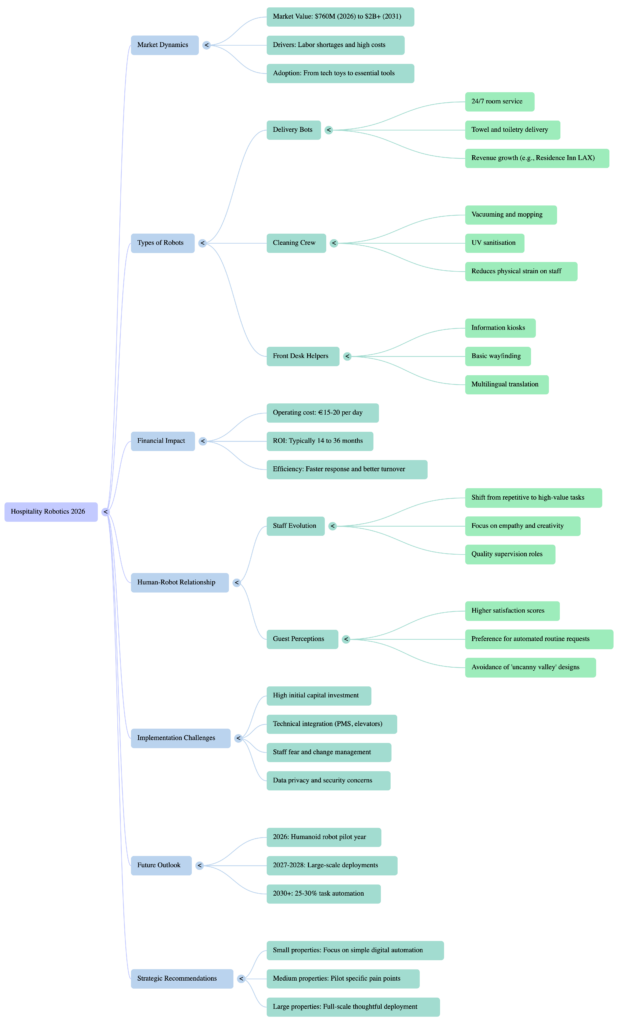
Hospitality Robotics 2026 Mind Map
References (selected key sources)
- Mordor Intelligence (2026). Hospitality Robots Market Size & Share Outlook to 2031
- National Restaurant News (2025). Labor shortages dominate restaurant concerns for 2026
- Deloitte (2026). The Future of Hospitality Report
- HospitalityNet (2026). What percentage of human employees in hospitality will be replaced by AI and robots by 2030?
- Caterer & Licensee (2026). The State of Hospitality Report 2025-2026, Les Roches
- Various case studies: Residence Inn LAX, Shangri-La Traders Hotel, Grand Azure Resort, Fusion Dining Group