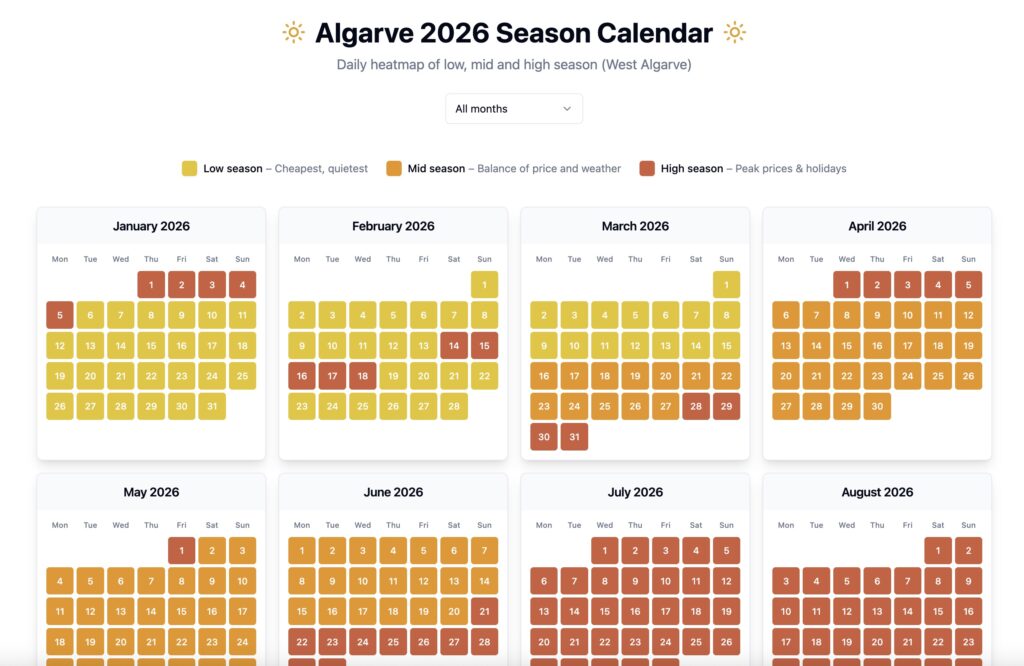
Owners of small accommodations in the Algarve often feel the seasons, but it is hard to turn that into a clear, simple system: which days are low season, when exactly the high season starts, and which weekends suddenly get busy because of holidays and school breaks.
That is why a new tool has been created on whereismax.pl – an Algarve 2026 season calendar, with every single day marked as:
- green – low season
- blue – mid season
- red – high / peak season
This tool is designed specifically for small hospitality businesses: apartments, holiday homes, guesthouses and small hotels.
link to the web app https://seasons.whereismax.pl
Where the data comes from and how the calendar works
The calendar is not “guessed” – it is based on real data and actual patterns in EU, including:
- official public holidays (for example 25 April, 1 May, 10 June, 15 August, 1 November, 25 December);
- Christian holidays and key travel periods: Easter, Christmas, New Year;
- Portuguese school holidays 2025/2026, which strongly affect when local families travel;
- practical tourism guides and analyses of the busiest months in the Algarve.
Based on this, every day of 2026 is assigned to one of three categories:
- Low season (green) – days when:
- there are no major holidays or long weekends,
- Portuguese kids are at school,
- airlines and hotels often lower prices to attract guests.
- Mid season (blue) – transition periods:
- good weather, but not full peak,
- plenty of foreign tourists but not everyone is on school holidays yet,
- prices higher than winter, lower than full summer.
- High season (red) – days and weeks that are typically:
- the most expensive (flights, accommodation, car rental),
- the busiest (beaches, restaurants, activities),
- linked to big holidays or school vacations: Easter, July–August, Christmas, New Year, key long weekends.
The web app turns this into a year‑view heatmap calendar – you look at 2026 like a map: where it is red, demand and prices usually go up; where it is green, you have more room for offers and longer stays.
Why some days suddenly show as “high season”
For a small hospitality business, it is important to understand why a single day or short period is marked as high season, even if it is “just a weekend”.
Some key examples:
- Easter 2026 (28 March – 5 April) Portugal has school holidays then, and many European countries also have time off. The result:
- surge in family bookings,
- higher flight prices,
- visibly higher occupancy across the Algarve – almost like a mini‑July.
- Summer: 21 June – 5 September This is continuous high season – schools are closed, the weather is stable, and Portugal + the rest of Europe head to the coast. The result:
- strong demand for family apartments (2–3 bedrooms),
- higher price tolerance,
- 7–14‑night bookings made well in advance.
- 15 August – Assumption of Mary (Assunção) This is a major national religious holiday and a traditional vacation period for Portuguese families. Many pricing calendars show this week as the single most expensive of the year – even if the weather is similar to July.
- Christmas and New Year (23–31 December) Even though it is winter, the Christmas–New Year period in the Algarve is marked red as high season because:
- some guests escape colder Northern Europe,
- others want Christmas and New Year breaks in a milder climate.
In the app, these stretches appear as blocks of red days – a visual signal: “this is where you can increase prices” and “this is where guests will book earlier”.
How small accommodation owners can use this
For owners of apartments, holiday homes, guesthouses and small hotels in the Algarve, this calendar is a practical pricing and planning tool:
- Better price management
- on “red” weeks you can confidently test higher nightly rates,
- on “green” weeks you can run promotions and longer‑stay discounts (e.g. -10% from 7 nights) to lift occupancy.
- Setting minimum stay rules
- in high season you can safely set 5–7 night minimums,
- in low season, drop to 2–3 nights to attract short breaks and remote workers.
- Planning marketing campaigns
- in “green” periods, promote special offers (e.g. for digital nomads, couples, remote workers),
- in “red” periods, focus on families and school‑holiday travellers who expect to pay more but want good value.
- Clear communication with guests You can clearly explain why July–August is more expensive than May or October – backed by a visual calendar of holidays and demand, not just “because that’s the season”.
What the calendar on seasons.whereismax.pl gives you
In the app on seasons.whereismax.pl, you can:
- view the entire year 2026 on a single screen,
- quickly identify:
- the best times to push rates up,
- the quieter windows where you should boost marketing or add offers,
- the ideal slots for your own vacation, when your calendar is mostly green.
The goal is not a “magic forecast”, but a practical map that connects:
- public holidays,
- school breaks,
- and typical tourism patterns in the Algarve.
If you run a small hospitality business in the region, this calendar is built to help you:
guess less, plan more – especially around pricing, minimum stay and availability.